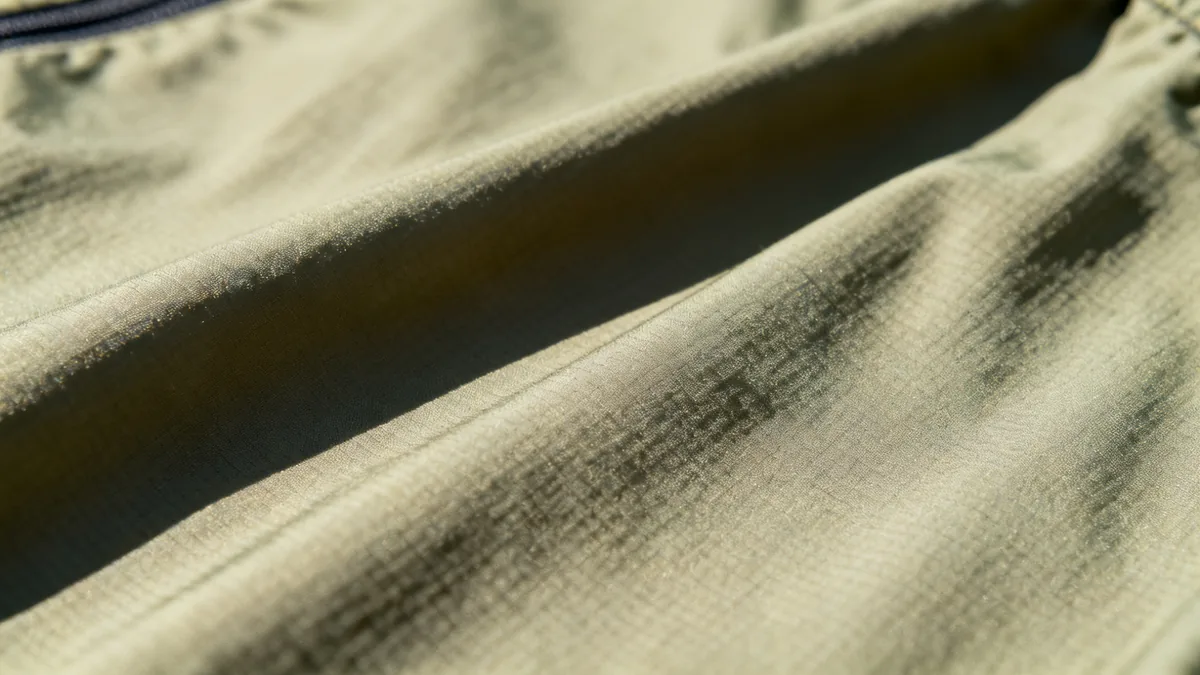
Why 'which fabric' is really three questions
When I took over purchasing in 2020, I assumed fabric was fabric. Get three quotes, pick the middle one, move on. That worked fine for printer paper. It stopped working the first time I bought rain shells for our field service crew — nine jackets, all marked waterproof, three of them soaked through inside two weeks.
Here's what I know now: 'what fabric should we buy' is at least three different questions wearing the same coat. For context, I'm the office administrator for a 180-person company — engineering plus a field service division. I manage facilities and gear purchasing, roughly $310,000 a year across about 14 vendors, and I answer to both operations and finance. I'm not a textile chemist. I'm the person who signs the PO, which turns out to be a useful place to stand.
The three situations I keep running into:
- Weather protection. People work outside in the rain. This is a membrane-and-laminate question.
- Hand protection. Cold, wet hands on a ladder. Different product, different care routine, different failure mode.
- Next-to-skin textiles. Uniforms, liners, office-worn clothing that touches skin eight hours a day. That's a fiber question — lyocell, viscose, blends.
And a fourth case that fits none of them, which I'll save for the end — it's where I see the most money wasted.
Scenario A: the people wearing it get rained on
If the wearer spends forty minutes in sustained rain, you aren't buying a fabric. You're buying a laminate and a construction. That distinction cost me about $1,100 to learn.
What a gore tex membrane actually is
The membrane is the functional layer — a thin expanded PTFE film, and more recently an expanded polyethylene version, bonded to a face fabric. It never ships alone. So the line item on your quote is a laminate: membrane plus face fabric, and in 3-layer constructions, an inner backer as well. When I first went looking, I was searching 'gore tex membrane' and getting spec sheets I could not read. Once I understood I was pricing laminates rather than films, the quotes started making sense.
The names you'll see: GORE-TEX PACLITE® is a lightweight 2-layer build where a thin protective coating replaces the inner liner — packable, and a bit slick against bare arms in warm weather, which some of my crew complained about. GORE-TEX Performance Shell shows up as general-purpose 2-layer and 3-layer laminates. For a crew standing in a parking lot in February, Performance Shell is usually the more honest buy than the lightest thing available.
The part nobody puts on the quote
The membrane does not keep you dry by itself. Seams, zips, hood, hem, and the durable water repellent on the face fabric all share that job. This is the single most common misunderstanding I run into internally — people think the logo on the chest is a guarantee. It isn't. It's a specification, and the factory still has to execute it.
Case in point on the DWR: when the face fabric wets out, the shell stops breathing, and the wearer gets clammy from the inside. That's not a membrane failure. It usually means the water repellent needs refreshing. Nobody teaches you that. I learned it from a rep who was patient with a dumb question.
Per FTC business guidance on advertising (ftc.gov), performance claims like 'waterproof' must be truthful and substantiated with evidence. If a supplier can't hand you test data, that's your answer.
Two practical checks I now run before signing anything in this category. First, the trademark: GORE-TEX® appears in capitals with the ® mark, and legitimate fabric comes through licensed manufacturers. A spec sheet that says 'gore tex' in lowercase, or 'gore-tex style', is a flag — and I've seen both. Second, the size of the ask. Nine jackets is a rounding error to a mill, and I've been quoted a custom-run minimum for what was really a stock-program purchase. Ask specifically whether there's distributor stock in your color and size range before you accept an MOQ number. To be fair, minimums exist for real reasons — dye lots aren't free — but the minimum for a custom color is not the minimum for a jacket.
Small doesn't mean unimportant. The vendors who took our nine-jacket order seriously in 2021 are the ones quoting our sixty-jacket orders now.
Scenario B: the problem is hands, specifically
Gloves fail differently from jackets. A jacket has to keep rain out. A glove has to keep rain out, keep grip usable, and survive the fact that your hand is producing sweat the entire time.
For cold and wet together, the construction that has held up for us is a leather shell over a membrane insert — the Hestra Army Leather GORE-TEX® line is what our field leads settled on after two winters of trial and error. The leather takes the abrasion and gives you grip on wet metal; the membrane insert is a separate glove-shaped liner inside, doing the waterproofing. Two different materials, two different care routines. If your team treats them like plain leather work gloves and dries them on a truck dashboard, the leather cracks and the insert delaminates, and then it's my budget again.
Here's the counterintuitive part, and it's the one I wish I'd known sooner: not everyone who works outside in winter needs a membrane glove. If your people are in and out of a truck cab all day and their hands don't actually get wet, you're paying a premium for waterproofing they'll experience as sweaty hands. A plain leather glove with a wool liner serves that crew better and costs less. I bought membrane gloves for the whole team the first year. About a third of them stopped wearing them.
Buy a size run and let people try before you commit to a full rollout. Glove fit with an insert doesn't follow the sizing of the work gloves your crew already owns, which means the size they tell you is not always the size they need.
Scenario C: the fabric touches skin all day
Now the office side. Uniform shirts, liner layers, event apparel, the soft goods that sit against skin for eight hours. Here the question is fiber, and lyocell versus viscose is the comparison that comes up most.
Lyocell fabric characteristics, in plain terms
Lyocell is a regenerated cellulose fiber made from wood pulp, spun in a solvent process with high solvent recovery. What that buys you on the wearer's side: it's smooth and drapes well, it manages moisture, it holds its shape better than viscose when wet, and it takes a peached finish that feels expensive. What it costs you: more per meter, and a fiber that still wants gentle washing. It's also a name people search for because it sounds sustainable — more on that below.
What is viscose fabric, then
Viscose is the older cellulose route: wood pulp dissolved and regenerated by a different process. Softer on cost, extremely absorbent, lovely drape, and genuinely cheap compared to lyocell. The tradeoffs are real — lower strength when wet, more shrinkage, more wrinkling. One labeling detail worth knowing: in the US, the legal generic name on the label for this fiber is 'rayon', not 'viscose'. Under 16 CFR Part 303, fiber content has to be disclosed by generic name, and lyocell and rayon are separate recognized names. So a garment tag reading 'viscose' is almost always rayon in US terms — same fiber family, different regulatory word. Useful when you're comparing two quotes that look identical on paper.
Where the eco-claims need scrutiny
Every lyocell pitch I've sat through leans on the closed-loop solvent story. Some of it is legitimate. Under the FTC Green Guides (16 CFR Part 260), environmental claims need substantiation, and a process claim is still a claim. Ask for the mill's certification — bluesign® or OEKO-TEX® are the two I check for — and treat 'eco-friendly' with no paperwork behind it the same way you'd treat a waterproof claim with no test data. Which is to say: as marketing.
The trap in this scenario
This is the one that goes against what everyone assumes. If your uniforms go through a commercial or industrial laundry, neither lyocell nor viscose is the right answer. Both are cellulose fibers with limited wet strength, and industrial wash cycles are brutal. You want a poly/cotton blend that survives the tunnel washer. Save the lyocell for the office-facing and retail-facing items that get washed at home or on a gentle in-house cycle, where the hand-feel actually gets noticed by someone.
Whatever you pick, wash-test a sample before the bulk order. Two shirts, one hot wash, one dryer cycle. It's a $60 experiment that has saved me from a $6,000 mistake.
How to tell which scenario you're actually in
Four questions. Answer them in order and stop at the first yes.
1. Does the wearer spend more than twenty minutes in sustained rain? Scenario A. Go get laminate specs and seam taping details, and stop shopping on price alone.
2. Are the hands, specifically, getting cold and wet — gloves on wet metal or wet rope? Scenario B. Leather shell, membrane insert, and a care routine written down for the crew.
3. Is it next-to-skin for eight hours a day, washed in-house, and seen by customers or candidates? Scenario C. That's where the lyocell premium earns its keep, on the shirts people actually notice.
4. Does it go through an industrial laundry? If yes, none of the above — poly/cotton, and put the money into fit instead of fiber.
One more variable that isn't about fabric at all. If your order is under twenty-five units, the vendor conversation changes more than the material choice does. Ask about stock programs, ask about a size run, ask what the real minimum is for an existing colorway before you accept a custom-run number. Small orders don't deserve smaller service — they deserve a straighter answer about what's actually in stock.
Bottom line
I spent two years treating fabric as one decision and paid for it in reorders. It's three decisions, plus a fourth case where the premium option is the wrong one. Ask what the garment has to survive — rain, grip, laundry, or a customer's eyes — and the material choice mostly makes itself. Where it doesn't, and it usually doesn't, the tiebreaker is whether the supplier will show you the paperwork. Wet-out, delamination, and shrinkage all look the same on a quote. Only one of them shows up on a test report.
